

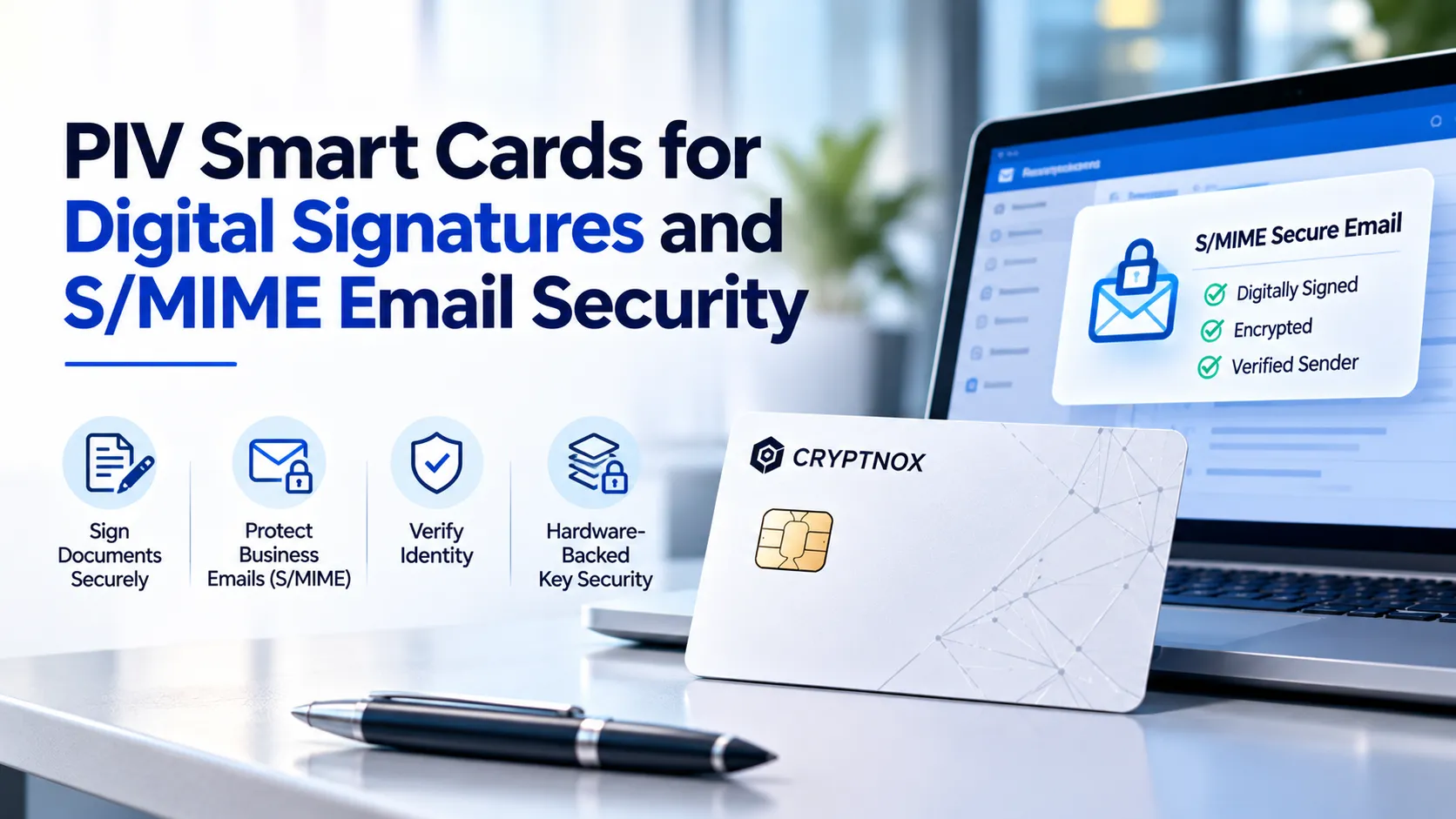
A PIV card for digital signatures provides a hardware-based way to verify identities and protect electronic communications using cryptographic credentials. Instead of relying entirely on passwords or software-stored private keys, a PIV-compatible smart card can securely hold cryptographic keys and perform signing operations through its integrated chip.
For businesses, government organizations, legal professionals, and enterprise IT teams, digital signatures and secure email communication are essential parts of information security. Documents often contain confidential information, approvals, contracts, and legally significant decisions. Similarly, email remains a common channel for exchanging sensitive business information.
PIV smart cards can support both document signing and S/MIME email security through certificate-based authentication. By keeping private keys protected within a physical credential, organizations can strengthen identity verification, establish document integrity, and reduce exposure to common credential theft risks.
What Is a PIV Card for Digital Signatures?
A PIV (Personal Identity Verification) card is a smart-card-based credential designed to support secure identity verification through cryptographic technologies. PIV-compatible cards can store digital certificates and protect associated private keys used for authentication, encryption, and digital signing, depending on their configuration.
A PIV card for digital signatures allows users to sign electronic documents using a private key protected by the card. The recipient can then use the corresponding public key and certificate to verify the signature.
Unlike a simple image of a handwritten signature, a cryptographic digital signature provides technical evidence that:
-
The document was signed using the corresponding private key.
-
The document has not been modified after signing.
-
The signing certificate can be associated with an identified credential holder.
-
The signature can be independently verified using appropriate software.
The strength of this process depends on secure key generation, certificate trust, private-key protection, and appropriate identity verification during certificate issuance.
How Does Smart Card Document Signing Work?
Smart card document signing uses public key cryptography to create a digital signature without exposing the private key to the computer or application requesting the signature.
The process generally involves four steps.
1. Certificate issuance
An organization uses a trusted certificate authority (CA) to issue a digital signing certificate to an authorized employee. The certificate contains the public key and identity information, along with relevant usage restrictions and validity details.
The corresponding private key is stored or protected by the smart card, depending on its architecture.
2. Document preparation
The user opens a document in compatible signing software, such as a supported PDF application. The software prepares the document data or its cryptographic hash for signing.
3. Cryptographic signing
The user presents the smart card and completes the required PIN verification. The card performs the signing operation using the protected private key.
The private key itself is not exported to the application during a properly implemented signing operation.
4. Signature verification
The recipient opens the signed document using compatible verification software. The software checks the signature against the signer’s public key and certificate.
It can also evaluate certificate validity, trust chains, timestamps, and revocation information where supported.
A PIV smart card for document signing can therefore provide a practical hardware-based approach to signing business documents, provided the card’s capabilities and certificate configuration are compatible with the selected signing application.
What Is S/MIME Email Security?
S/MIME (Secure/Multipurpose Internet Mail Extensions) is a widely used standard for securing email through digital certificates and public key cryptography.
It supports two important security functions:
Email signing: A digital signature allows recipients to verify the sender’s certificate and detect whether the signed message has been altered after signing.
Email encryption: The sender encrypts a message using the recipient’s public key. The recipient uses the corresponding private key to decrypt it.
A smart card can protect the private keys used for these operations.
How Does an Email Signing Smart Card Work?
When an employee sends a digitally signed email, the email client uses the signing certificate associated with the smart card.
The process typically works as follows:
-
The user composes an email in a compatible email application.
-
The application calculates the cryptographic hash of the message.
-
The smart card performs the signing operation using the protected private key.
-
The application attaches the digital signature and relevant certificate information.
-
The recipient’s email client verifies the signature using the sender’s public certificate.
If the message is modified after signing, signature verification can identify the integrity problem.
An email signing smart card can help organizations protect signing credentials against unauthorized extraction, subject to its security architecture and implementation.
For email encryption, organizations must also manage encryption certificates and recovery procedures carefully. Losing access to an encryption private key can make previously encrypted messages inaccessible if no suitable recovery mechanism exists.
Why Enterprises Use PIV Smart Cards for Document and Email Security
Organizations handling sensitive information need more than basic access controls. They also need reliable ways to establish who approved a document and whether a communication has been modified.
PIV-compatible smart cards can contribute to this security architecture in several ways.
Hardware-backed private-key protection
Keeping private keys within a smart card can reduce the risk of exposing them through compromised computers or software environments. The card performs cryptographic operations without ordinarily revealing the underlying private key.
Improved document integrity
Digital signatures make it possible to detect changes made to signed documents. This is useful for contracts, compliance records, financial approvals, and internal authorization workflows.
Stronger email authenticity
S/MIME signatures help recipients verify the certificate associated with a sender and identify modifications to signed messages.
Centralized certificate management
Enterprise PKI systems can manage certificate issuance, renewal, expiration, and revocation. This makes it easier to establish consistent signing policies across departments.
What Should Organizations Consider Before Deployment?
A successful deployment requires coordination between smart-card hardware, certificate infrastructure, endpoint devices, and software applications.
IT administrators should evaluate the following:
-
Certificate compatibility: Confirm that certificates support the intended digital-signature and S/MIME use cases.
-
Cryptographic algorithms: Verify that the card and applications support compatible algorithms and key sizes.
-
Application integration: Check compatibility with PDF signing tools, email clients, operating systems, and smart-card middleware.
-
PIN protection: Establish secure PIN policies and procedures for failed attempts and credential replacement.
-
Certificate lifecycle: Define processes for issuing, renewing, suspending, and revoking certificates.
-
Backup and recovery: Establish appropriate procedures for encrypted email credentials and business continuity.
-
Legal requirements: Determine whether the signing method meets the applicable electronic-signature regulations and organizational requirements.
It is particularly important to distinguish technical digital-signature validity from legal acceptance. A cryptographically valid signature does not automatically qualify as a legally recognized signature in every jurisdiction. Applicable laws, identity verification procedures, certificate policies, and signing workflows must also be considered.
Choosing a PIV-Compatible Smart Card
When evaluating a certificate signing smart card, organizations should examine its documented cryptographic capabilities, supported standards, private-key protection mechanisms, and compatibility with their existing PKI infrastructure.
The Cryptnox Hardware Wallet Smartcard Dual is one option organizations can evaluate when considering smart-card-based security. Before deployment, verify the product’s current technical specifications and confirm whether its supported interfaces, cryptographic functions, and certificate workflows meet the requirements for document signing and S/MIME integration.
A suitable card must work as part of a complete security system. Hardware protection, certificate management, user authentication, and application compatibility all contribute to the effectiveness of the deployment.
Conclusion
A PIV card for digital signatures provides organizations with a hardware-based method of protecting private keys used for electronic document signing and secure email communication. By combining smart-card technology with digital certificates and public key cryptography, businesses can strengthen document integrity, support sender verification, and improve control over sensitive signing credentials.
S/MIME extends these capabilities to email by supporting message signing and encryption, while compatible document-signing applications can use smart cards to create independently verifiable digital signatures.
For enterprise IT teams, successful implementation depends on selecting compatible hardware, establishing reliable PKI processes, and managing certificates throughout their lifecycle. When these elements work together, PIV-compatible smart cards can become a valuable component of a broader enterprise identity and information security strategy.